 Install FontSwap

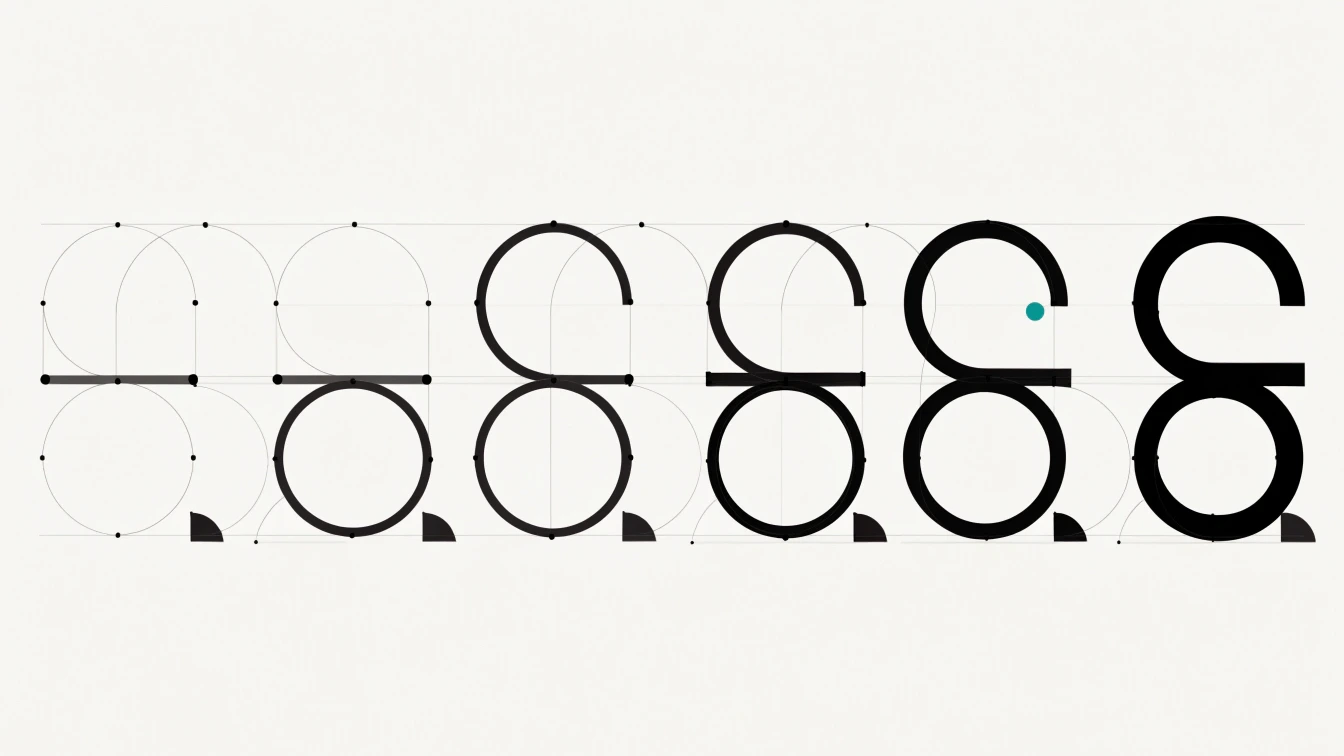
Yes, you can use Fontzz in commercial work. The LICENSE file in the Fontzz repository says “This Font Software is licensed under the SIL Open Font License, Version 1.1” and declares no Reserved Font Name. That licence covers the font files. It says nothing about what the model behind them learned from. The authors have not said, and we cannot vouch for it.
Fontzz is a set of 36 type families that Hassan (@nutlope on X) announced as “available today” on 2 November 2026, with Youssef credited as co-author. This article reads the licence, the repository and the build scripts. It explains how the fonts are made and sets five of them against established Google Fonts families, using files we measured.
Fontzz FAQ
Is Fontzz free for commercial use?
Yes. The README says the fonts and the generator are released under the OFL 1.1, “so they’re free for personal and commercial use but can’t be sold on their own”. That matches the OFL 1.1 text in the LICENSE file.
Is Fontzz MIT or OFL?
OFL 1.1. On 30 October, Hassan replied “will be MIT!” to a user who said the licence file due on Monday mattered most to him, because client work can only ship fonts that are clearly allowed. The files published on 2 November say OFL 1.1 in the LICENSE, in the OFL.txt inside each download, in the README and in the font metadata. Follow the files.
Can I sell Fontzz fonts?
Not on their own. You can bundle them in something you sell, such as an app or a template, if each copy carries the copyright notice and the licence text.
Are the fonts really AI-generated?
That is the authors’ description on X. The README says only that the families are “drawn entirely in code”. Hassan wrote that “The model writes a python generator where every letter is code”. The repository holds the Python generator, with no model calls or prompts in it.
Does Fontzz cover Cyrillic or Greek?
No. The five families we read each map 285 characters: Latin-1, 67 of the 128 Latin Extended-A characters, figures, currency symbols and arrows. None has Greek, Cyrillic or Vietnamese additions. The README skips Cyrillic and Greek for now.
What Fontzz is
The repository is Nutlope/fontzz. It was created on 21 October 2026. As of 2 November it has 14 commits, all under the git name “Youssef”. The README credits “Hassan and Youssef”, and so does the font metadata. Hassan’s X bio reads “Director of Developer Experience @togethercompute”, and Youssef’s GitHub profile reads “Product Designer @ Together AI”. Hassan’s source post says a model on Together AI made the fonts. That is his claim, and the repository neither shows nor refutes it.
The 36 families fall into four groups on the Fontzz site:
- Sans, 12. Halden (neo-grotesque), Rondel (geometric), Mallow (rounded), Strata (condensed) and eight more.
- Serif, 12. Ledger (slab), Folio (text serif), Opaline (Didone), Meridian (transitional) and eight more.
- Display, 9. Vesper, Topsy, Orbit, Diode, Marquee and four more.
- Mono, 3. Signal, Tally and Fathom.
Each family is one variable font with a single wght axis from 100 to 900, built from three masters at 100, 400 and 900. In the five files we read, fvar has that one axis and nine named instances, Thin to Black. Downloads also include nine static weights and WOFF2 files. There are no italics yet.
None of the five families is hinted. The variable TTFs and the nine statics of each have no fpgm or prep table and no glyph instructions, and gasp holds a single range. The README lists hinting the statics as unfinished work.
What the OFL lets you do with them
Google Fonts adds only fonts licensed under the OFL, and its FAQ says you can use them commercially, “and even include them within a product that is sold commercially”. For Fontzz, the conditions that matter are these:
- Use is free. Websites, apps, print, logos and video titles need no extra permission. The OFL FAQ lists signage, stationery and t-shirts too.
- No selling the font on its own. Bundling the files with software is allowed.
- Keep the notice with every copy. If you redistribute the files, in a repository or a downloadable template, include the copyright line and the licence text. The line in the files reads, for Halden, “Copyright 2026 The Halden Project Authors (https://github.com/Luffixos/fontzz)”. Copy it as shipped.
- Modified versions stay OFL. The OFL FAQ counts subsetting as modification, and some WOFF conversion tools too. Fontzz ships its own WOFF2 files, so use those unchanged. Redistributed modified files must stay under the OFL.
- No Reserved Font Name. Fontzz declares none, so you can rename a modified version. The authors’ names still cannot be used to promote it.
- Documents are not bound. A PDF, a poster or an image made with the fonts is outside the licence. The FAQ says embedding the font in a document is fine.
- Web use is allowed. The FAQ’s answer on loading fonts through CSS
@font-faceis “Yes! Go ahead!” - Embedding flags are open.
OS/2fsTypeis 0 in every Fontzz file we read, which sets no embedding restriction.
For how OFL, Apache and MIT differ, see our licence decision tree and the licence guide. This is a factual reading of the licence, not legal advice.
Where the MIT mention came from
The MIT line comes from one reply on 30 October. The LICENSE file published on 2 November is the grant. GitHub’s licence panel for the repository reads “Other”, which is its automatic detector’s result for this file, and the file text itself is OFL 1.1. If a client’s lawyer asks, point them to the LICENSE and to the OFL.txt in each download.
What about the generator code?
The README says “The fonts and the generator are released under the SIL Open Font License 1.1”. The OFL text defines Font Software as the files released under the licence, and says that “may include source files, build scripts and documentation”.
AI-generated fonts: the provenance caveat
The OFL covers the font files. It does not settle where the model’s knowledge came from, and the authors have not published what it was trained on.
Thomas Phinney wrote on TypeDrawers on 19 June 2026, about a font described as 100% AI-generated: “At least under US copyright law, there is no copyright on AI-generated materials, and as far as I understand it, that means AI generated fonts cannot be licensed under the Open Font License.” He allowed that hybrid cases with human editing “might be possible”, but said that “still rules out simply licensing the font under the OFL”. That is one expert’s forum opinion, not a ruling, and it concerned a different font. The Fontzz authors have not said how much of the generator or any outline a person wrote or edited.
The OFL FAQ, entry 1.25, covers the other direction. A font made by an AI system whose input or training data includes OFL font sources “should be considered a derivative work” and must stay under the OFL. Whether any of Fontzz’s inputs were fonts is not stated.
For a product UI or a marketing site, the authors’ OFL grant is the practical basis. For a logotype, or any project that needs a documented chain of title, ask the authors in writing or choose a family with published sources.
How the fonts are made
Hassan’s reply to a question about how model output becomes an installable TTF starts “it’s quite interesting:” and continues: “1. The model writes a python generator where every letter is code (widths, curves and serifs are parameters) 2. fontmake compiles them into a ttf file 3. fontTools makes them into WOFF2s”.
The repository matches the second and third steps. The type/ folder holds the generator, a kerning module and a release script, with pinned fontmake, fontTools and skia-pathops. The README says every TTF and WOFF2 passes OTS, the sanitizer Chrome and Firefox run on web fonts. We ran the OTS sanitizer (opentype-sanitizer 9.2.0) on the variable TTF, the WOFF2 and the Regular static of each of the five families. All 15 files passed.
Kerning is computed “from glyph side profiles” for each master. The monospace and pixel families skip it. The repository has no OpenType features file, and the files agree: none of the five has a GSUB table, so no ligatures, stylistic sets, small caps, fractions or alternate figures. Four have a kern feature in GPOS, with 652 to 2,493 pair records and no class kerning. Signal, the monospace, has no GPOS at all. The README lists code ligatures and a slashed zero for Signal and Tally as future work.
The model name and cost come from one source. Hassan’s post says the fonts “only cost $0.02 each with DeepSeek V4.1 Flash 1017” on Together AI. Nothing in the repository supports or contradicts it, so we report it as his claim.
Can you use an AI font generator like this?
Fontzz is not a generator tool. It is the output of one workflow, plus the scripts it produced. You can rebuild the 36 families with release.py, but the repository has no prompt and no model step. What you can copy is the method: a model writes parameters and code, and standard tools compile the font.
Simon Cozens wrote on 22 June 2026 that current Latin font generation models are “pretty woeful”, and that spacing and kerning are “the real hard parts of Latin font design”. His survey covers raster models with a vectorising step, not a model that writes parametric code, and he sets legal questions aside. His view is context for Fontzz, not a verdict on it. We found no independent review of Fontzz’s quality as of 2 November 2026.
How Fontzz compares with established open fonts
We paired five Fontzz families with well-known OFL families from Google Fonts in the same genre. These are neutral genre comparisons, not substitution advice. We measured the files with fontTools 4.68.0 on 2 November 2026: Fontzz at commit 7a3499f, Google Fonts at commit 2fe1e8c. Both x-height and width are taken at wght 400 with other axes at their default, as a share of the 1,000-unit em. “Kerned pairs” counts glyph pairs after class kerning is expanded, so a file with more scripts counts more. Source Serif 4 and IBM Plex Mono have no page on this site yet.
For the monospaces, “Avg width” is the advance width. The renders below use Chromium, the same text and the same CSS size for every font in an image, and the optical size axes at their default.
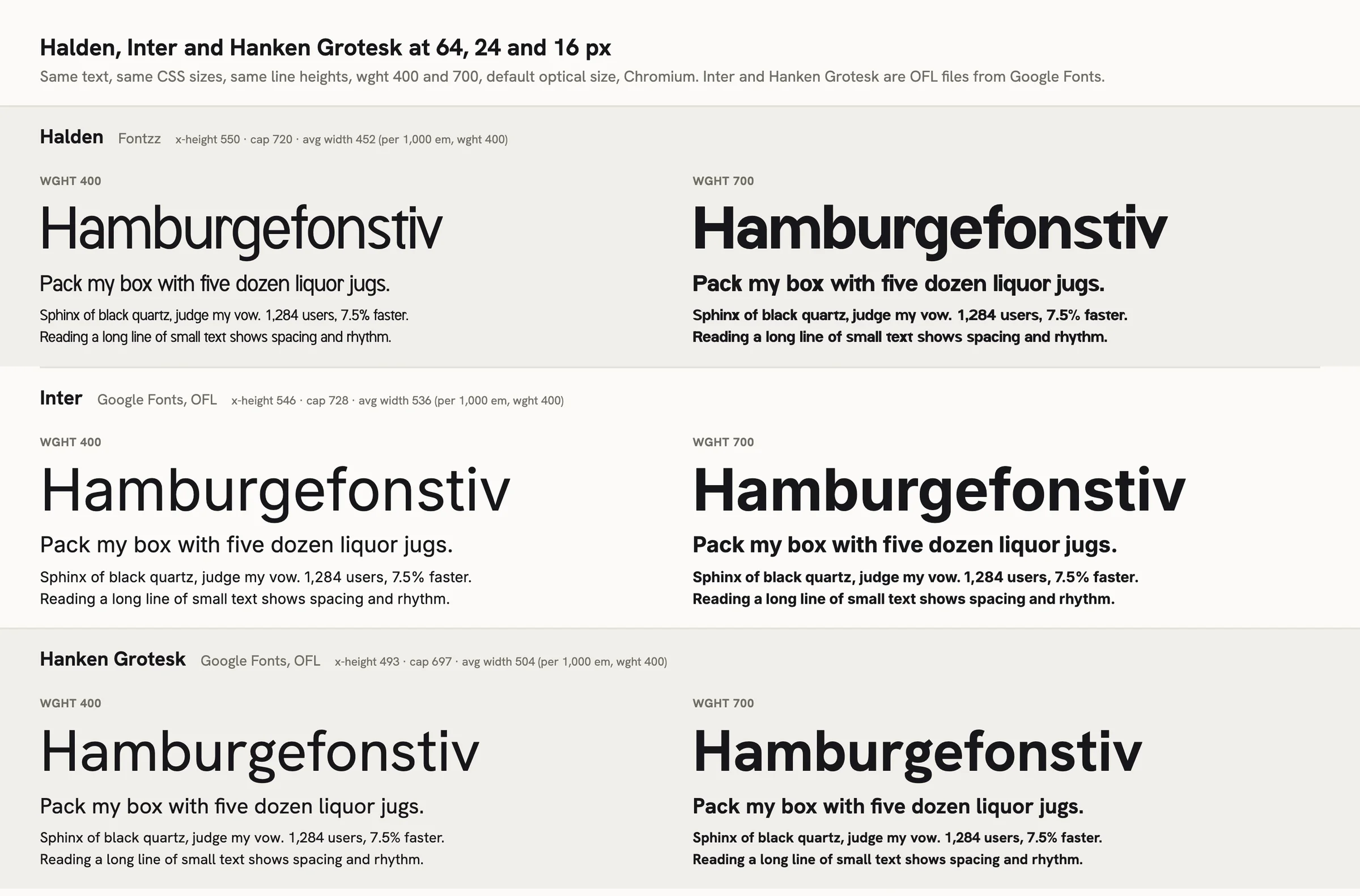
Halden at 400 reads lighter and narrower than Inter and Hanken Grotesk at the same setting, which the width column matches. Weight numbers are not comparable across families.
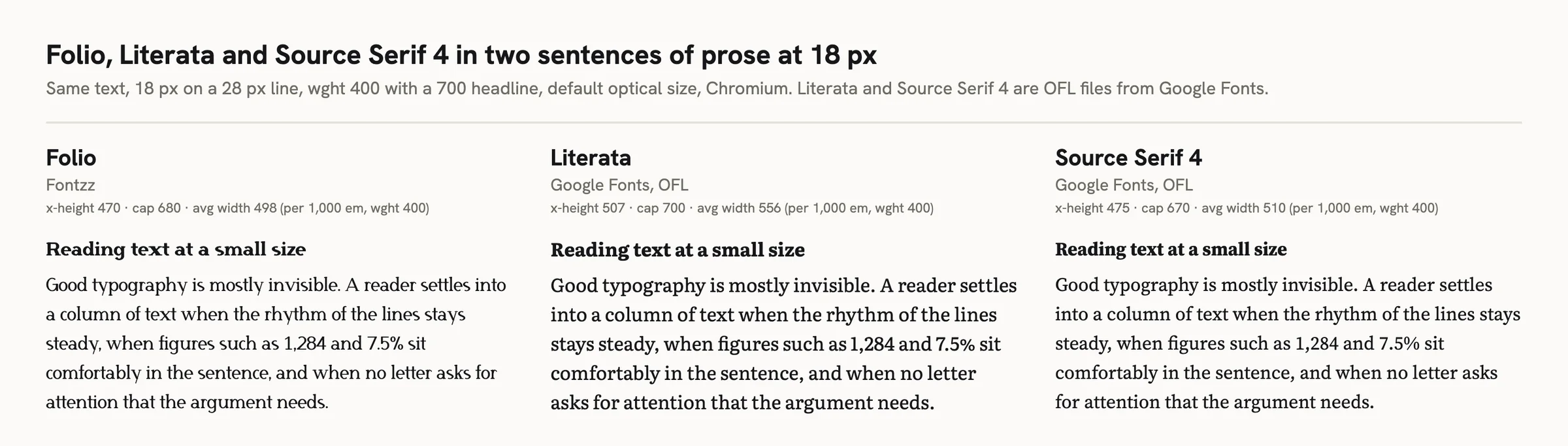
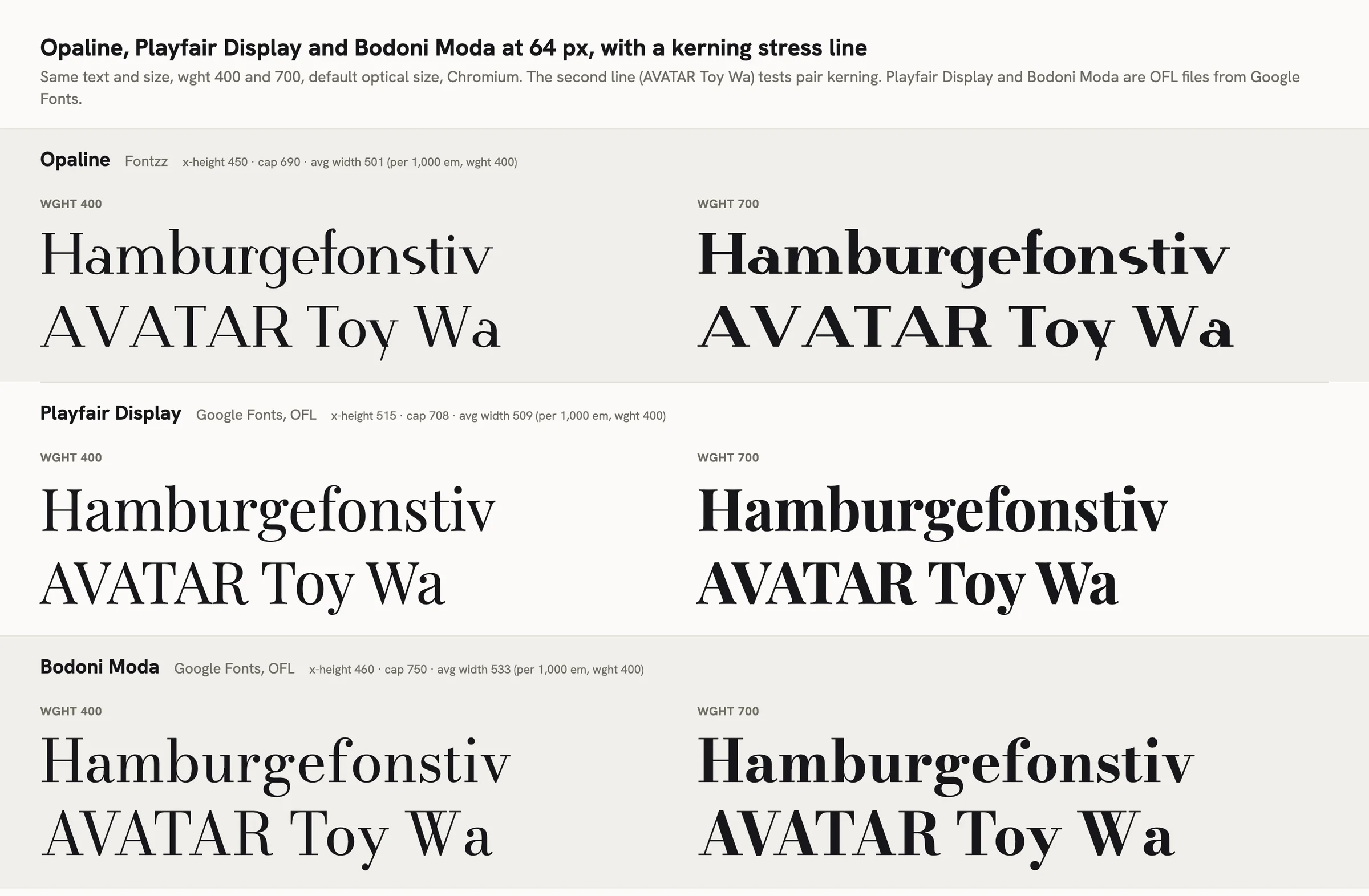
At weight 700, Opaline’s thinnest strokes shrink to hairlines. In the 64 px render the spine of the s and the tail of the y are the thinnest parts.
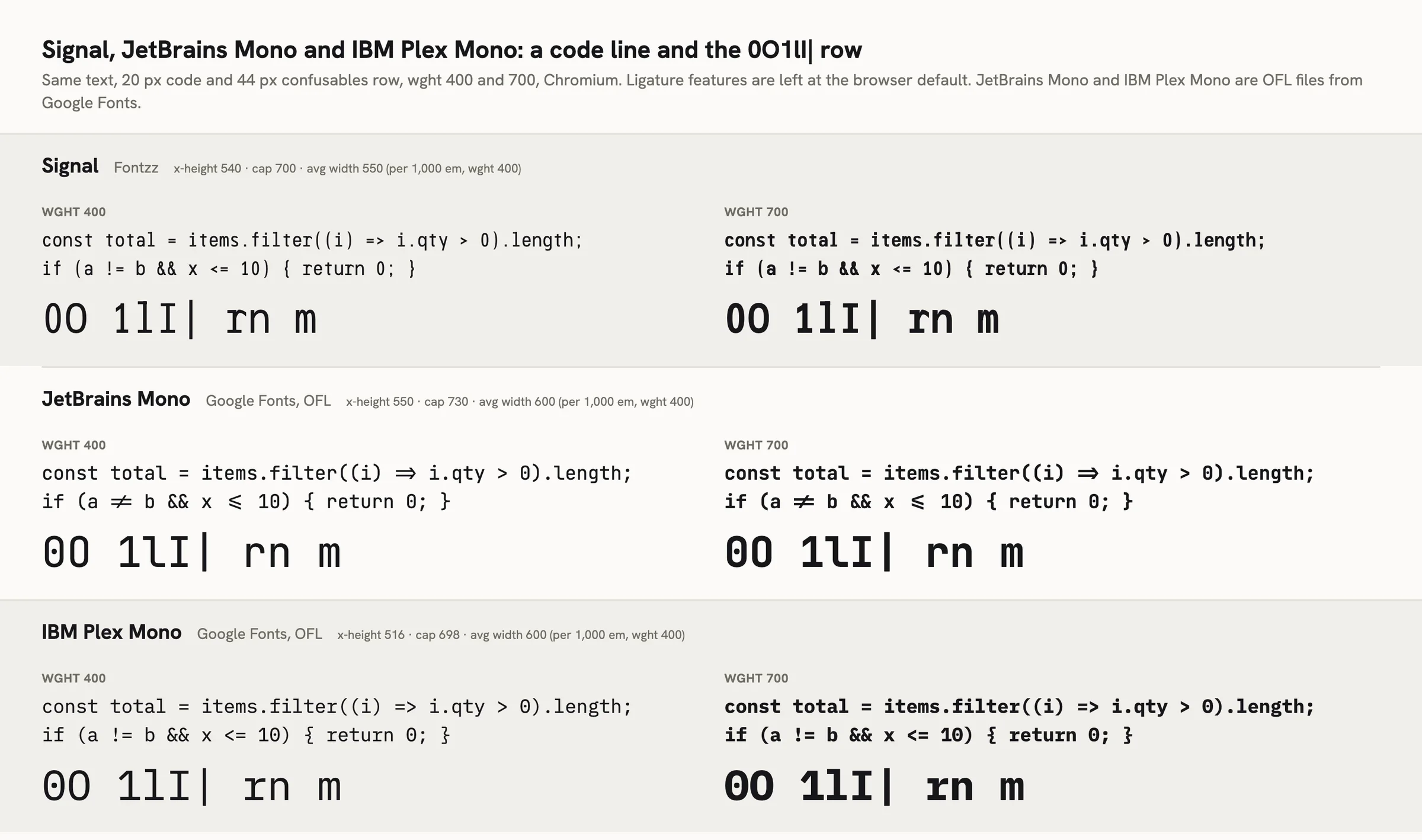
Signal draws its zero without a dot or slash, and it has no zero feature to switch one on. JetBrains Mono and IBM Plex Mono draw a dotted zero. JetBrains Mono also turns =>, != and <= into ligature glyphs by default in this render, and Signal and Plex Mono do not.
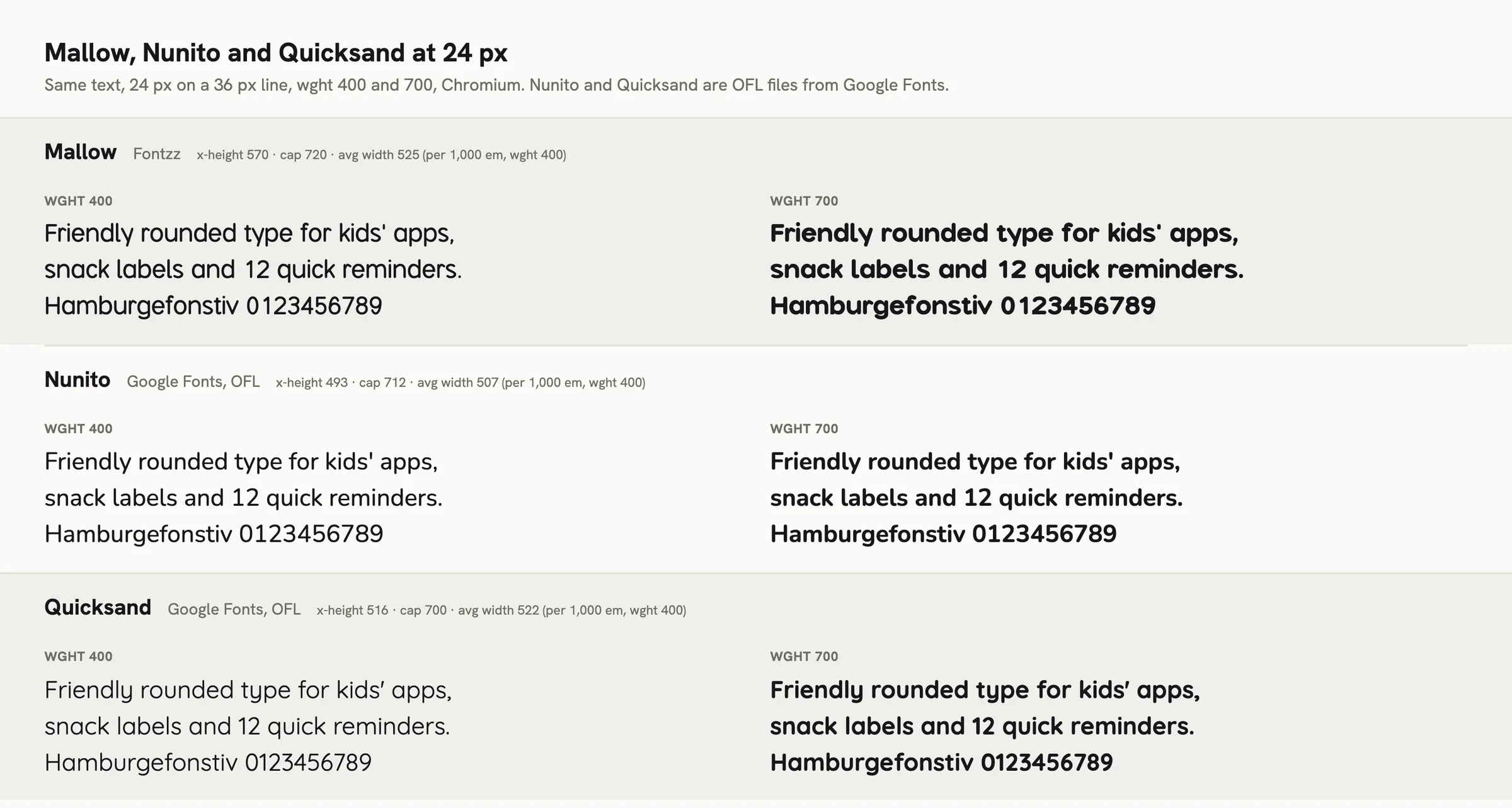
What the numbers show: Fontzz has less coverage, fewer features and far less kerning data than the comparison fonts, and its basic proportions are close to theirs in some pairs. Each Fontzz family maps 285 characters against 428 to 2,849 in the comparison files, and none has a GSUB table, while all ten comparison fonts have one. Kerned pairs run from 0 to 2,493 for Fontzz and from 9,708 to 451,705 for the nine non-monospace comparison fonts.
On x-height, four Fontzz families sit within 10 units of one comparison font: Halden 550 against Inter 546, Folio 470 against Source Serif 4 at 475, Opaline 450 against Bodoni Moda at 460, and Signal 540 against JetBrains Mono at 550. Mallow’s 570 is higher than Quicksand’s 516 and Nunito’s 493. Lowercase width differs more. Halden, Folio and Opaline are narrower than both of their comparison fonts, and Signal’s advance of 550 compares with 600 for both monospaces. Mallow is wider than Nunito and Quicksand, by 17 and 3 units.
Three more things we measured:
- Scripts. Fontzz is Latin only. Greek and Cyrillic characters mapped, in that order: Inter 105 and 248, Literata 87 and 118, Source Serif 4 80 and 150, JetBrains Mono 77 and 98. Cyrillic with at most five Greek characters: Playfair Display 4 and 122, IBM Plex Mono 1 and 168, Nunito 5 and 220. Hanken Grotesk (10 and 0), Bodoni Moda (4 and 0) and Quicksand (1 and 0) have no Cyrillic.
- Axes. Fontzz has one
wghtaxis and no italic. Inter, Literata, Source Serif 4 and Bodoni Moda also ship an optical size axis. Hanken Grotesk, Playfair Display, JetBrains Mono, Nunito and Quicksand havewghtonly, and the IBM Plex Mono files we used are static. - Hinting. None of the Fontzz files has glyph instructions. Neither do the variable files of the comparison fonts. Only IBM Plex Mono, which is static, has them, on 604 of its 1,033 glyphs.
File size is the clearest difference. The README puts the WOFF2 files of the 36 families at “9 to 36 KB”. The five we measured are 16 to 35 KB. We re-compressed the nine variable comparison fonts to WOFF2 with fontTools, and they come to 53 to 424 KB.
What to check before you ship Fontzz
- Keep the
OFL.txtfrom each download with any copy you redistribute. - Test your text. Latin only. If your content needs Cyrillic, Greek or Vietnamese, pick another family.
- Check the figures. The site’s own prompt says every family except Diode defaults to tabular figures. In the five we measured, the digits 0 to 9 share one advance width at weight 400, so table columns align. With no
GSUBtable there are no proportional or old-style figures to switch to. Five comparison fonts default to proportional figures (Inter, Literata, Playfair Display, Bodoni Moda and Quicksand), and Inter, Literata and Bodoni Moda offertnumfor tabular ones. - Render at your sizes, on Windows and macOS, before you commit. The files are unhinted.
- Decide how much provenance you need. See the caveat above.
Sources
- Fontzz repository and LICENSE, checked 2 November 2026.
- Hassan on X: source post, 30 October, the “will be MIT!” reply, the method reply and the launch post, 2 November.
- OFL 1.1 text, OFL FAQ and Google Fonts FAQ.
- Thomas Phinney, TypeDrawers, 19 June 2026 and Simon Cozens, The State of AI Font Generation, 22 June 2026.
- Measurements, scripts and renders:
docs/blog-fact-checks/data/fontzz/in the site repository.