Free Alternatives to Garamond

About Garamond
- Foundry
- Adobe
- Classification
- serif
- Style
- old-style
Brands Using Garamond
Think Different campaign era and early macOS system font
Retail branding and in-store signage
Book series interior text in US editions
Brand identity for the culinary arts institution
Body text in select editorial features
 See Garamond live on these sites with FontSwap →
Garamond is a group of old-style serif typefaces named after the 16th-century Parisian engraver Claude Garamont. Adobe Garamond, designed by Robert Slimbach in 1989, is among the most widely used revivals, capturing the elegance and readability that made the original a cornerstone of Western typography. For nearly five centuries, Garamond has remained the standard for book typography and literary publishing.
History and Design
Claude Garamont's types, created in the 1530s and 1540s, represented a significant evolution from earlier Venetian designs. Working in Paris during the Renaissance, Garamont refined the letterforms pioneered by Italian printers, creating types that were more refined, more elegant, and more readable. His letterforms featured greater refinement, improved proportions, and a distinctive elegance that influenced type design for centuries. The gentle bracketed serifs, moderate x-height, and graceful curves define the Garamond aesthetic.
The name "Garamond" has become somewhat generic, applied to numerous typefaces with varying degrees of historical accuracy. The confusion began when typographers mistakenly attributed Jean Jannon's 17th-century types to Garamont. Modern digital versions range from scholarly reconstructions to creative interpretations. Adobe Garamond, ITC Garamond, and Stempel Garamond each represent different approaches to the Garamond legacy.
Adobe Garamond Pro, released in 1989 and later expanded as an OpenType font, is based on original Garamont punches from the Plantin-Moretus Museum in Antwerp. Robert Slimbach's design faithfully captures the warmth and humanist qualities of the original while adding modern features and extensive language support. The italic is based on types by Robert Granjon, Garamont's contemporary, following historical practice.
Why Garamond Endures
Garamond's longevity stems from its exceptional readability and timeless elegance. The letterforms feel both classical and approachable, making it equally suitable for dense academic texts and refined luxury branding. Its moderate contrast and open counters facilitate comfortable extended reading—essential for books meant to be read for hours.
The typeface achieved particular prominence in publishing. Countless novels, from literary fiction to academic monographs, have been set in Garamond variants. Publishers favor it because it's economical with space while remaining highly legible, allowing more text per page without sacrificing readability. Some studies suggest Garamond uses up to 24% less ink than comparable fonts, making it popular for printing large volumes.
Beyond publishing, Garamond has found favor in luxury branding where its historical provenance and refined character communicate heritage and sophistication. Wine labels, fashion houses, and premium products leverage Garamond's associations with tradition and quality.
Use Cases
Garamond excels in:
- Book design: A favorite for novel and literary fiction typesetting
- Editorial: Magazine features and long-form journalism
- Academic publishing: Scholarly journals and dissertations
- Luxury branding: Wine labels, fashion, and high-end products
Finding Free Alternatives
EB Garamond stands as the premier free alternative, meticulously crafted from historical sources by Georg Duffner and later expanded by Octavio Pardo. Named after the Égenolff-Berner specimen sheet of 1592, this revival represents scholarly dedication to authentic Garamond reproduction. The variable font version offers weights from Regular to ExtraBold, making it versatile for both text and display applications. For book designers seeking authentic Garamond character without commercial licensing, EB Garamond is the definitive choice.
Cormorant Garamond offers a more dramatic interpretation with increased stroke contrast and refined details. Christian Thalmann designed it specifically for display typography, making it particularly striking for headlines, titles, and feature layouts. While sharing Garamond's essential character, Cormorant's higher contrast creates visual drama at large sizes. The family includes Infant, Upright, and Small Caps variants for design flexibility.
For projects requiring both text and display sizes, consider pairing EB Garamond for body copy with Cormorant Garamond for headlines—a combination that maintains Garamond family consistency while optimizing each weight for its intended use.
FAQ
What is the best free alternative to Garamond?
EB Garamond is the best free alternative to Garamond, offering exceptional fidelity to Claude Garamont's original 16th-century designs. Georg Duffner created this revival using historical sources, making it suitable for book design, editorial work, and academic publishing where authentic Garamond aesthetics are essential.
Can I use EB Garamond commercially?
Yes, EB Garamond is licensed under the SIL Open Font License (OFL-1.1), which permits commercial use without fees or royalties. You can use it in print materials, websites, applications, and products. The license requires attribution if you redistribute the font itself.
How similar is EB Garamond to Adobe Garamond?
EB Garamond achieves approximately 92% similarity to Adobe Garamond, capturing the essential character of Claude Garamont's original designs. Both feature the characteristic old-style proportions, gentle bracketed serifs, and elegant curves. Minor differences exist in specific letterforms and spacing.
What are the main differences between Garamond and EB Garamond?
Adobe Garamond offers more refined optical adjustments and extensive OpenType features developed by professional type designers. EB Garamond has slightly different spacing and a few alternate letterforms. For most practical applications, EB Garamond provides comparable quality and visual consistency.
Where can I download EB Garamond for free?
EB Garamond is available for free download from Google Fonts at fonts.google.com/specimen/EB+Garamond. The font includes regular and italic styles across multiple weights, plus a variable font version. Installation is straightforward on Windows, macOS, and Linux systems.
Is Garamond on Google Fonts?
No, Garamond is a premium font from Adobe and is not available on Google Fonts.
The closest Google Fonts alternative is EB Garamond with 92% similarity. Get it free on Google Fonts ↗
Free Alternatives (2)
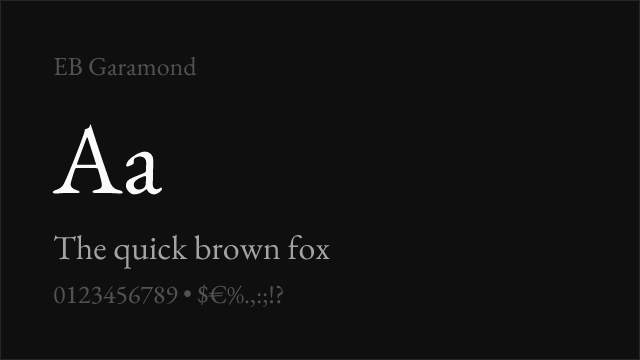
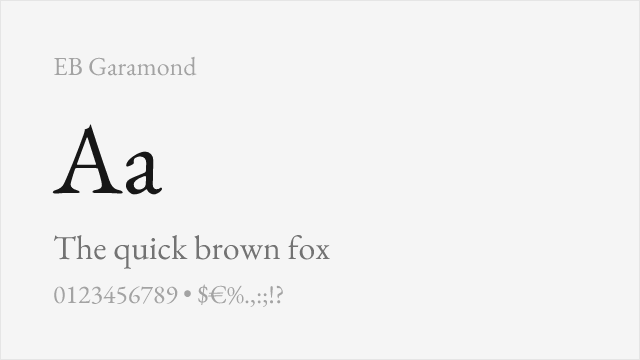
Exceptional revival based on Claude Garamont's original 16th-century designs
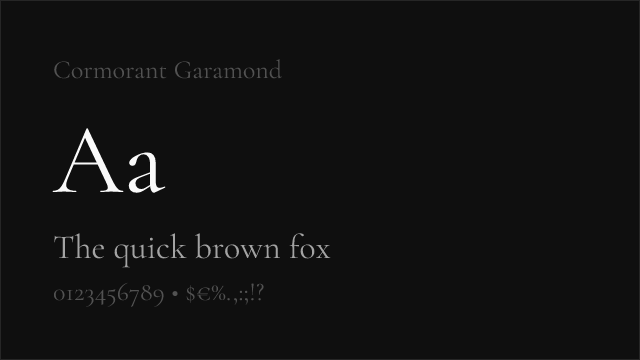
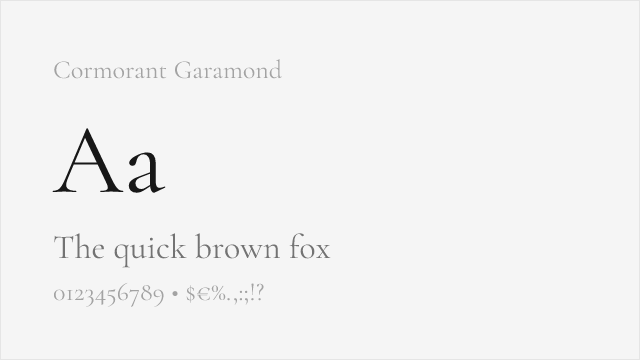
More decorative interpretation with higher contrast for display use
Replacement Summary
Source: FontAlternatives.com
Premium font: Garamond
Best free alternative: EB Garamond
FontAlternatives similarity score: 92%
Replacement difficulty: Low
Best for: book design, academic publishing, editorial design, literary fiction
Notable users: Apple, Abercrombie & Fitch, Harry Potter
Not recommended when: Brand consistency with Apple requires exact letterforms
What is the best free alternative to Garamond?
EB Garamond is the best free alternative to Garamond with a FontAlternatives similarity score of 92%.
EB Garamond shares similar proportions, stroke characteristics, and intended use with Garamond. It is available under the OFL-1.1 license, which permits both personal and commercial use at no cost.
This alternative works particularly well for: book design, academic publishing, editorial design, literary fiction.
Can I safely replace Garamond with EB Garamond?
Yes, EB Garamond is a high-confidence replacement for Garamond. The FontAlternatives similarity score of 92% indicates strong structural compatibility.
Licensing: EB Garamond is licensed under OFL-1.1, which allows commercial use without licensing fees or royalties.
Weight coverage: All 3 weights have exact matches available.
When should I NOT replace Garamond?
While EB Garamond is a strong alternative, there are situations where replacing Garamond may not be appropriate:
- Brand consistency: Garamond is commonly seen in Book publishing contexts where exact letterforms may be required.
- Strict compliance: Verify that OFL-1.1 terms meet your specific legal and compliance requirements.
Weight-Matching Guide
Map Garamond weights to their closest free alternatives for accurate font substitution.
EB Garamond
| Garamond | EB Garamond | Match |
|---|---|---|
| Regular | Regular (400) | exact |
| Semibold | SemiBold (600) | exact |
| Bold | Bold (700) | exact |
Performance Guide
Production performance metrics for each alternative.
How to Use EB Garamond
Copy these code snippets to quickly add EB Garamond to your project.
CSS code for EB Garamond
@import url('https://fonts.googleapis.com/css2?family=EB+Garamond:wght@100..900&display=swap');HTML code for EB Garamond
<link rel="preconnect" href="https://fonts.googleapis.com">
<link rel="preconnect" href="https://fonts.gstatic.com" crossorigin>
<link href="https://fonts.googleapis.com/css2?family=EB+Garamond:wght@100..900&display=swap" rel="stylesheet">
Tailwind code for EB Garamond
// tailwind.config.js
module.exports = {
  theme: {
    extend: {
      fontFamily: {
        'eb-garamond': ['"EB Garamond"', 'sans-serif'],
      },
    },
  },
}

// Usage in HTML:
// <p class="font-eb-garamond">Your text here</p>
Next.js code for EB Garamond
// Using next/font (Next.js 13+)
import { EB_Garamond } from 'next/font/google';

const eb_garamond = EB_Garamond({
  subsets: ['latin'],
  weight: ['100', '200', '300', '400', '500', '600', '700', '800', '900'],
});

export default function Component() {
  return (
    <p className={eb_garamond.className}>
      Your text here
    </p>
  );
}

// Or using inline styles with Google Fonts link:
// <p style={{ fontFamily: '"EB Garamond"' }}>Your text</p>
Expo and React Native code for EB Garamond
// Install: npx expo install @expo-google-fonts/eb-garamond expo-font
import { useFonts, EB_Garamond_400Regular } from '@expo-google-fonts/eb-garamond';

export default function App() {
  const [fontsLoaded] = useFonts({
    EB_Garamond_400Regular,
  });

  if (!fontsLoaded) return null;

  return (
    <Text style={{ fontFamily: 'EB_Garamond_400Regular' }}>
      Your text here
    </Text>
  );
}
Recommended Font Pairings
These free fonts pair well with EB Garamond Garamond for headlines, body text, or accent use.
Open Sans's clean neutrality lets Garamond's old-style elegance shine as the primary reading face
Lato's humanist warmth harmonizes with Garamond's classical proportions for a cohesive editorial feel
Source Sans Pro's readable simplicity pairs well with Garamond's refined serifs in academic and editorial settings
Frequently Asked Questions
What is the best free alternative to Garamond?
EB Garamond is the best free alternative to Garamond with a FontAlternatives similarity score of 92%. It shares similar proportions and characteristics while being available under the OFL-1.1 license for both personal and commercial use at no cost.
Is there a free version of Garamond?
There is no official free version of Garamond. However, EB Garamond is available under the OFL-1.1 open-source license and achieves a FontAlternatives similarity score of 92%. It includes variable weights and supports latin, latin-extended.
What Google Font looks like Garamond?
The Google Fonts most similar to Garamond are EB Garamond, Cormorant Garamond. Among these alternatives, EB Garamond offers the closest match with a FontAlternatives similarity score of 92% and includes variable weights for flexible typography options.
Can I use EB Garamond commercially?
Yes, EB Garamond can be used commercially. It is licensed under OFL-1.1, which allows free use in websites, applications, print materials, and commercial projects without purchasing a license or paying royalties.
Is EB Garamond similar enough to Garamond?
EB Garamond achieves a FontAlternatives similarity score of 92% compared to Garamond. While not identical, it offers comparable letterforms, proportions, and visual style. Most designers find it works excellently as a substitute in web and print projects.
What are the main differences between Garamond and its free alternatives?
Free alternatives to Garamond may differ in subtle details like letter spacing, curve refinements, and available weights. Premium fonts typically include more OpenType features, extended language support, and optimized screen rendering. However, for most projects, these differences are negligible.
Where can I download free alternatives to Garamond?
Download EB Garamond directly from Google Fonts. Click the "Get Font" button on any alternative listed above to visit the official download page. Google Fonts also provides convenient embed codes for seamless web integration.