Free Alternatives to Baskerville

About Baskerville
- Foundry
- Monotype
- Classification
- serif
- Style
- transitional
Brands Using Baskerville
Official government publications and communications
Brand identity and retail signage
Store signage and private label packaging
 See Baskerville live on these sites with FontSwap →
Baskerville is a transitional serif typeface designed by John Baskerville in Birmingham, England, in the 1750s. Positioned between old-style typefaces like Garamond and modern faces like Bodoni, Baskerville represents a crucial evolution in type design with its refined letterforms and improved contrast. This transitional masterpiece bridged the gap between Renaissance typography and modern rationalism.
History and Design
John Baskerville (1706-1775) was a writing master and printer who obsessed over every aspect of book production. He developed improved printing presses, created smoother papers (the forerunner of wove paper), and designed type that could showcase these innovations. His typeface featured sharper serifs, more vertical stress, and greater contrast than contemporary old-style faces—characteristics that would later define the modern style.
Baskerville spent years perfecting his types, cutting punches with unprecedented precision. The results were letterforms of remarkable clarity: crisp serifs, elegant curves, and balanced proportions that seemed to hover between the warmth of humanist designs and the precision of what would come later. His famous 1757 edition of Virgil's works demonstrated the typeface's capabilities.
Baskerville's types were initially criticized in England as too refined and sharp for comfortable reading. Some complained the high contrast strained the eyes. However, Benjamin Franklin admired them greatly, defending Baskerville in a famous letter where he tricked a critic into praising Baskerville's work when presented as Caslon. The designs found success in America and continental Europe before gaining belated appreciation in Britain.
After Baskerville's death, his punches and matrices were purchased by French printer Beaumarchais to print the complete works of Voltaire. The types eventually passed through various hands before Monotype revived them in the 20th century, ensuring Baskerville's legacy for modern designers.
Why Baskerville Matters
Baskerville's historical significance extends beyond typography. Research has shown that readers perceive statements set in Baskerville as more credible than the same statements in other typefaces. This "Baskerville effect," demonstrated in a 2012 New York Times experiment, shows how typeface choice influences reader psychology. Participants rated identical statements as more "agreeable" and "truthful" when set in Baskerville compared to Comic Sans, Helvetica, or Georgia.
The typeface strikes an ideal balance between elegance and readability, making it suitable for extended reading while maintaining refinement for prestigious applications. Its transitional nature—neither too historical nor too modern—gives it remarkable versatility across contexts. Government institutions favor Baskerville for its trustworthy, authoritative character.
Modern digital versions include Monotype Baskerville, ITC New Baskerville, and Baskerville MT. Apple includes Baskerville in macOS, making it accessible to designers worldwide. Each revival interprets the original with slight variations, but all maintain the essential transitional character.
Use Cases
Baskerville excels in:
- Book design: Literary fiction and quality paperbacks
- Academic publishing: Journals, dissertations, and scholarly works
- Corporate communications: Annual reports and formal documents
- Editorial design: Magazine features and quality journalism
Finding Free Alternatives
Libre Baskerville stands as an excellent free alternative, specifically optimized for web use by Pablo Impallari. Rather than creating a strict historical revival, Impallari focused on practical screen readability. The hairlines are slightly heavier than traditional Baskerville, preventing the thinning and breakup that plagues high-contrast serif fonts on screens. This optimization makes Libre Baskerville exceptional for web body text, blog posts, and digital publications.
The font family includes Regular, Bold, and Italic styles—sufficient for most text applications. While limited compared to commercial Baskerville families with multiple weights and optical sizes, Libre Baskerville's quality makes it the definitive free choice for transitional serif typography on the web.
EB Garamond serves as a secondary alternative when warmer, more humanist character is desired. While technically an old-style serif, its refined proportions and book-optimized design share Baskerville's suitability for extended reading. EB Garamond's variable font version offers more weight flexibility than Libre Baskerville.
FAQ
What is the best free alternative to Baskerville?
Libre Baskerville is the best free alternative to Baskerville, specifically designed for optimal web readability by Pablo Impallari. It captures the refined elegance and transitional characteristics of Baskerville while incorporating modern improvements for digital screens. The font works exceptionally well for long-form content.
Can I use Libre Baskerville commercially?
Yes, Libre Baskerville is licensed under the SIL Open Font License (OFL-1.1), which permits unlimited commercial use. You can use it for websites, applications, print materials, and products without licensing fees. Attribution is only required if you redistribute the font files.
How similar is Libre Baskerville to Monotype Baskerville?
Libre Baskerville achieves approximately 90% similarity to Monotype Baskerville, capturing the essential transitional character with refined serifs and balanced contrast. Libre Baskerville was optimized specifically for screen readability, resulting in slightly heavier hairlines and adjusted spacing compared to print-focused versions.
What are the main differences between Baskerville and Libre Baskerville?
Monotype Baskerville offers more weights, optical sizes, and refined details developed over decades. Libre Baskerville provides three styles (regular, italic, bold) optimized for web use with slightly heavier hairlines for screen clarity. Both maintain the transitional aesthetic and professional appearance.
Where can I download Libre Baskerville for free?
Libre Baskerville is available for free download from Google Fonts at fonts.google.com/specimen/Libre+Baskerville. The font includes regular, bold, and italic styles. Google Fonts provides easy embedding options, CSS snippets, and comprehensive documentation for implementation.
Is Baskerville on Google Fonts?
No, Baskerville is a premium font from Monotype and is not available on Google Fonts.
The closest Google Fonts alternative is Libre Baskerville with 90% similarity. Get it free on Google Fonts ↗
Free Alternatives (3)
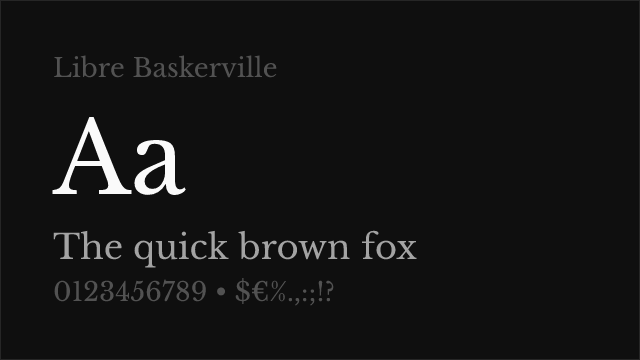
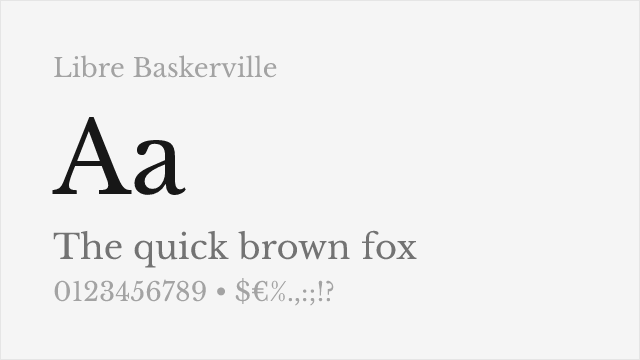
Excellent web-optimized revival with improved screen readability
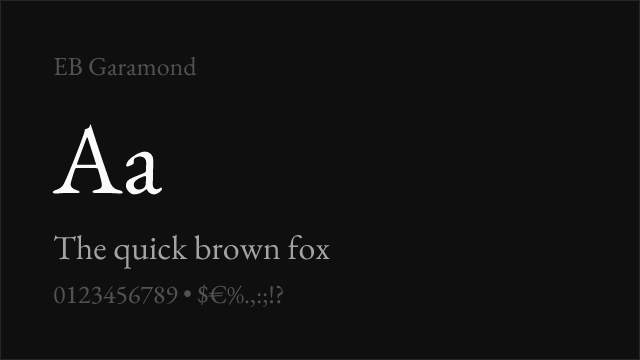
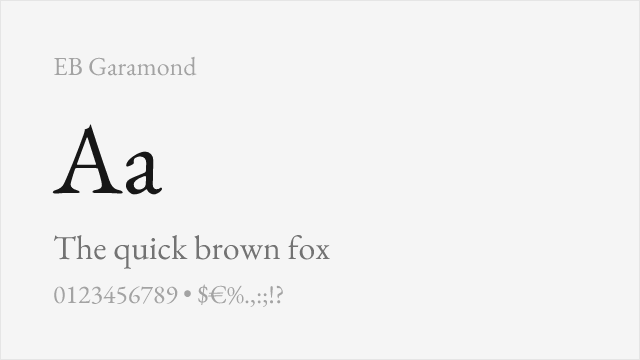
Similar transitional character with refined details for book design
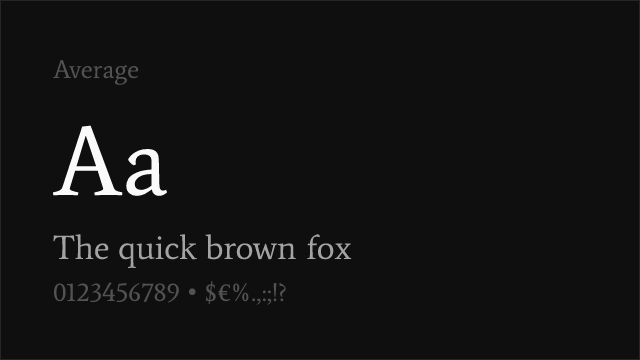
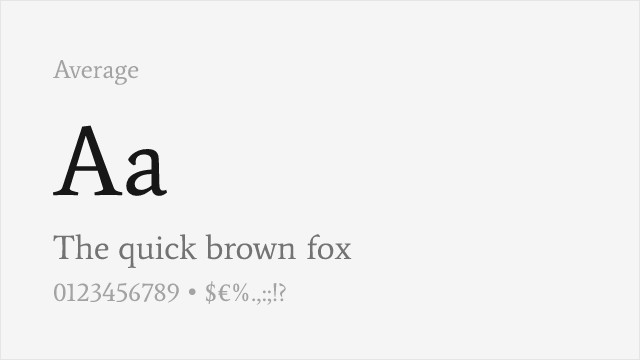
Measured text serif averaging classical traditions into a balanced reading face
Replacement Summary
Source: FontAlternatives.com
Premium font: Baskerville
Best free alternative: Libre Baskerville
FontAlternatives similarity score: 90%
Replacement difficulty: Low
Best for: web body text, digital publications, corporate websites, academic content
Notable users: Canadian Government, Kate Spade, WHOLE FOODS
Not recommended when: Brand consistency with Canadian Government requires exact letterforms
What is the best free alternative to Baskerville?
Libre Baskerville is the best free alternative to Baskerville with a FontAlternatives similarity score of 90%.
Libre Baskerville shares similar proportions, stroke characteristics, and intended use with Baskerville. It is available under the OFL-1.1 license, which permits both personal and commercial use at no cost.
This alternative works particularly well for: web body text, digital publications, corporate websites, academic content.
Can I safely replace Baskerville with Libre Baskerville?
Yes, Libre Baskerville is a high-confidence replacement for Baskerville. The FontAlternatives similarity score of 90% indicates strong structural compatibility.
Licensing: Libre Baskerville is licensed under OFL-1.1, which allows commercial use without licensing fees or royalties.
Weight coverage: All 2 weights have exact matches available.
When should I NOT replace Baskerville?
While Libre Baskerville is a strong alternative, there are situations where replacing Baskerville may not be appropriate:
- Extended language support: Libre Baskerville has limited cyrillic support compared to Baskerville.
- Brand consistency: Baskerville is commonly seen in Canadian government contexts where exact letterforms may be required.
- Strict compliance: Verify that OFL-1.1 terms meet your specific legal and compliance requirements.
Weight-Matching Guide
Map Baskerville weights to their closest free alternatives for accurate font substitution.
Libre Baskerville
| Baskerville | Libre Baskerville | Match |
|---|---|---|
| Regular | Regular (400) | exact |
| Bold | Bold (700) | exact |
Performance Guide
Production performance metrics for each alternative.
How to Use Libre Baskerville
Copy these code snippets to quickly add Libre Baskerville to your project.
CSS code for Libre Baskerville
@import url('https://fonts.googleapis.com/css2?family=Libre+Baskerville:wght@400;700&display=swap');HTML code for Libre Baskerville
<link rel="preconnect" href="https://fonts.googleapis.com">
<link rel="preconnect" href="https://fonts.gstatic.com" crossorigin>
<link href="https://fonts.googleapis.com/css2?family=Libre+Baskerville:wght@400;700&display=swap" rel="stylesheet">
Tailwind code for Libre Baskerville
// tailwind.config.js
module.exports = {
  theme: {
    extend: {
      fontFamily: {
        'libre-baskerville': ['"Libre Baskerville"', 'sans-serif'],
      },
    },
  },
}

// Usage in HTML:
// <p class="font-libre-baskerville">Your text here</p>
Next.js code for Libre Baskerville
// Using next/font (Next.js 13+)
import { Libre_Baskerville } from 'next/font/google';

const libre_baskerville = Libre_Baskerville({
  subsets: ['latin'],
  weight: ['400', '700'],
});

export default function Component() {
  return (
    <p className={libre_baskerville.className}>
      Your text here
    </p>
  );
}

// Or using inline styles with Google Fonts link:
// <p style={{ fontFamily: '"Libre Baskerville"' }}>Your text</p>
Expo and React Native code for Libre Baskerville
// Install: npx expo install @expo-google-fonts/libre-baskerville expo-font
import { useFonts, Libre_Baskerville_400Regular } from '@expo-google-fonts/libre-baskerville';

export default function App() {
  const [fontsLoaded] = useFonts({
    Libre_Baskerville_400Regular,
  });

  if (!fontsLoaded) return null;

  return (
    <Text style={{ fontFamily: 'Libre_Baskerville_400Regular' }}>
      Your text here
    </Text>
  );
}
Recommended Font Pairings
These free fonts pair well with Libre Baskerville Baskerville for headlines, body text, or accent use.
Montserrat's geometric sans-serif forms provide modern contrast to Baskerville's classical transitional serifs for editorial layouts
Open Sans's neutral humanist character pairs cleanly with Baskerville's refined serifs for digital publications and corporate communications
Source Sans Pro's systematic clarity complements Baskerville's sophisticated character for professional documents and academic content
Browse Alternatives by Context
Find Baskerville alternatives filtered by specific use case, style, or language support.
By Use Case
By Script
Frequently Asked Questions
What is the best free alternative to Baskerville?
Libre Baskerville is the best free alternative to Baskerville with a FontAlternatives similarity score of 90%. It shares similar proportions and characteristics while being available under the OFL-1.1 license for both personal and commercial use at no cost.
Is there a free version of Baskerville?
There is no official free version of Baskerville. However, Libre Baskerville is available under the OFL-1.1 open-source license and achieves a FontAlternatives similarity score of 90%. It includes 2 weights and supports latin, latin-extended.
What Google Font looks like Baskerville?
The Google Fonts most similar to Baskerville are Libre Baskerville, EB Garamond, Average. Among these alternatives, Libre Baskerville offers the closest match with a FontAlternatives similarity score of 90% and includes 2 weights for design flexibility.
Can I use Libre Baskerville commercially?
Yes, Libre Baskerville can be used commercially. It is licensed under OFL-1.1, which allows free use in websites, applications, print materials, and commercial projects without purchasing a license or paying royalties.
Is Libre Baskerville similar enough to Baskerville?
Libre Baskerville achieves a FontAlternatives similarity score of 90% compared to Baskerville. While not identical, it offers comparable letterforms, proportions, and visual style. Most designers find it works excellently as a substitute in web and print projects.
What are the main differences between Baskerville and its free alternatives?
Free alternatives to Baskerville may differ in subtle details like letter spacing, curve refinements, and available weights. Premium fonts typically include more OpenType features, extended language support, and optimized screen rendering. However, for most projects, these differences are negligible.
Where can I download free alternatives to Baskerville?
Download Libre Baskerville directly from Google Fonts. Click the "Get Font" button on any alternative listed above to visit the official download page. Google Fonts also provides convenient embed codes for seamless web integration.