 Install FontSwap

Universities are dropping licensed brand fonts because the licences got more expensive and no longer cover how a university actually uses type. Seat limits keep fonts away from most staff and students. Many licences don’t cover websites, apps or tools like Canva. And at least two universities say their supplier raised prices or changed the terms. Of the five universities below, three moved to free, open-source Google Fonts, one to fonts in its existing Adobe subscription, and one is developing its own typeface.
Every quote comes from the university’s own brand pages or announcements, apart from Guelph’s, which a university vice-president gave to GuelphToday. The sources are linked in each section.
ETH Zurich: a price rise and new terms
ETH Zurich’s corporate typeface is DIN Next, and you can still see it on ethz.ch today. On its staff intranet, ETH says it is replacing the typeface because of “a sharp increase in licensing costs and changes to the terms of use imposed by the previous provider” (ETH Staffnet).
The replacement is not a free font. ETH Next is a custom typeface, still in development, that ETH says can be used “without restriction and at no additional cost within the ETH context”. The website moves by the end of 2026, all digital applications by September 2027, and print by the end of 2028. Arial stays for PowerPoint, Word, email and documents shared with outside partners.
If you liked the DIN look, the free fonts closest to it are covered in our DIN alternatives.
Johns Hopkins: web, apps and seat limits
Johns Hopkins switched on September 4, 2025, and its brand team was blunt about why. Its contracts with Monotype, Type Tailors and Type Network “heavily limited typeface use on websites and prevented use on mobile apps, digital marketing communications, and third-party cloud software, such as Canva and Marq”. They also “limited the number of users who could access our licensed typefaces” (JHU Brand, September 4, 2025).
The replacements map one to one:
- Work Sans replaces Gentona (and its web stand-in, Proxima Nova).
- Oswald replaces Titling Gothic (and ATF Alternate Gothic).
- Source Serif 4 replaces Arnhem (and Freight Text). Our entry still uses its older name, Source Serif Pro.
- Roboto Slab replaced Quadon, as a stopgap.
The enforcement was real. Licensed fonts had to come off every JHU website, app and Canva or Adobe Express account, and “failure to remove the licensed typefaces will result in licensing fees being billed to the department responsible for their use.”
Quadon turned out to be the hardest to replace with an open-source font. On July 21, 2026, Hopkins released Hopkins Slab, a proprietary typeface drawn in-house by senior graphic designer Sara Austin. It replaces both Roboto Slab and Quadon (JHU Brand, July 21, 2026). The old licensed fonts survive only in logos and lock-ups, existing campaign and event graphics, permanent wayfinding signage and print publications.
Kentucky: per-style pricing
The University of Kentucky began phasing out Avenir, Trade Gothic and Surveyor on April 15, 2023, and finished on September 30, 2023. Its brand team gave three reasons (UK Brand, April 24, 2023):
- Cost. “The cost to license these fonts has increased substantially and it is no longer feasible to continue purchasing on behalf of the university.”
- The pricing model. Kentucky used to buy Avenir as one family with every variation included. “The new pricing model would require us to purchase Avenir bold, Avenir italics, etc. separately.”
- Compliance. On a large campus it “has proven increasingly difficult and resource-intensive to manage the font licenses”.
Kentucky did not go open source. Usual, ATF Alternate Gothic and Bodoni PT Variable all come from Adobe’s font library, which the university already licenses, so they “do not require additional licenses”. That still costs money, through a subscription the university already pays for. The change covers the main campus only, not UK HealthCare or UK Athletics. If you’re after a free Trade Gothic alternative, we list those separately.
Guelph: used beyond the licence
Guelph’s brand refresh was already underway when the owner of its old fonts told the university it had a licence problem. “While U of G’s brand evolution was underway, we were made aware by the owner of the fonts previously used in our brand system that we were using some licensed fonts beyond the original licensing terms,” Deirdre Healey, associate vice-president for communications and marketing, told GuelphToday in July 2025. “The issue was resolved, and our new visual identity uses open-source fonts.”
As of June 1, 2025, Guelph staff, departments and merchandise had to stop using Helvetica Neue, Serpentine, Bembo and Avenir Next (U of G brand guide). Bitter, a slab serif, is now the primary typeface, and DM Sans is the secondary one. The athletics brand, the Gryphons, pairs DM Sans with Russo One as its primary, headline typeface (Gryphons brand guide).
Uppsala: licence costs, then a cheaper pair
Uppsala University dropped Gill Sans and Berling in autumn 2023 “på grund av licenskostnader”, because of licence costs (Uppsala University, October 27, 2023). Staff used Arial and Times in the meantime.
In June 2024, the vice-chancellor approved the replacements. Work Sans took over from Gill Sans, and Cormorant Garamond took over from Berling. “These fonts are free to use and easily accessible in digital form online. As the previous visual identity fonts were subject to a fee, this will mean a financial saving” (Uppsala University, June 11, 2024).
What the free replacements look like
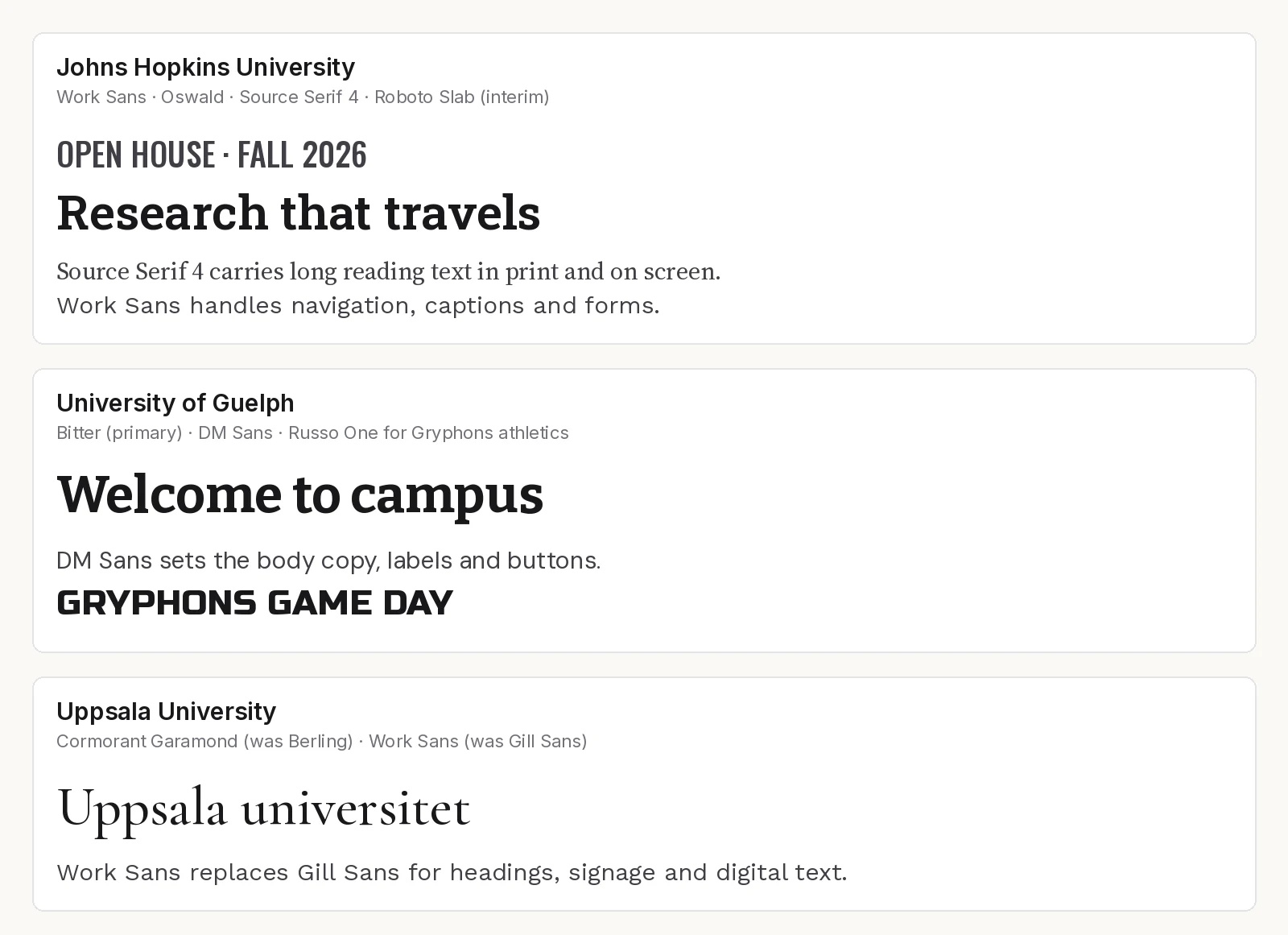
Rendered by us from the Google Fonts files. The sample text is ours, not the universities’ layouts. Johns Hopkins has since replaced Roboto Slab with its own Hopkins Slab.
All eight are on Google Fonts. Roboto Slab is licensed under Apache 2.0 and the other seven under the SIL Open Font License (Work Sans, Oswald, Source Serif 4, Bitter, DM Sans, Russo One, Cormorant Garamond), so they can be used commercially, embedded on websites and in apps, and uploaded to tools like Canva.
Work Sans shows up twice, replacing two quite different sans-serifs: a humanist sans at Uppsala (Gill Sans) and a neo-grotesque at Johns Hopkins (Gentona). It is a variable font with weights from 100 to 900.
What the five cases have in common
Seat licences don’t fit a university. A typical desktop licence covers a set number of computers. A university has thousands of staff, students who make posters, and freelancers and agencies. Johns Hopkins and Kentucky both said they couldn’t get fonts to everyone who needed them.
Web and app rights are the expensive part. Johns Hopkins already kept a second set of web “substitute” fonts, because its main contracts heavily limited use on websites. Cloud tools like Canva and Marq need yet another kind of permission. An open-source licence covers all of these at once.
Foundries change terms. Kentucky’s per-style pricing, ETH’s new terms of use, and the licence problem Guelph’s font owner raised all came from the supplier side. A university that owns its fonts, or uses open-source ones, can’t be repriced.
Free isn’t the only exit. Kentucky moved to fonts bundled with a subscription it already had. ETH is having a custom typeface made, and Johns Hopkins drew its own slab serif in-house. Only Uppsala and Guelph went fully open source, and Johns Hopkins did for three of its four fonts.
If you’re weighing the same move, the licence matters more than the price tag. Our guide to OFL, Apache and MIT font licences covers what each lets you do, including embedding in apps and uploading to cloud tools.