Install FontSwap

Docker’s new brand, launched on 19 November 2026, uses GT Planar as its primary typeface and GT Standard Mono as its secondary typeface. Both are paid fonts from Grilli Type, and Docker’s guidelines name DM Sans and DM Mono, free on Google Fonts, as the fallbacks.
Docker announced the rebrand in a post by its CMO, Terri Avnaim. The post says Docker made a new version of its whale, Moby, with the brand transformation company Motto. The font names come from the “Typefaces” section of Docker’s brand guidelines. In Docker’s words, “Where custom fonts can’t be used, DM Sans and DM Mono are the fallbacks.”
What font is in the new Docker logo?
Docker does not say. The guidelines describe three logo assets: the symbol, the logotype and the combination mark. They name GT Planar as the primary typeface for “primary brand messaging, headlines and key moments”. They do not say which font, if any, the “docker” logotype was drawn from. Neither does Docker’s launch post.
A logotype is artwork, not live text. Brands often draw or adjust the letters by hand, so typing “docker” in GT Planar may not reproduce it. We did not compare the logo against any GT font, because we did not open one.
Docker offers a logo kit on the same page, with rules for using it. The symbol and the combination mark must be at least 24 px tall. The clear space around the logotype is the width of its “o”.
What the docker.com website loads
The guidelines list two typefaces. The website’s stylesheet uses three. We read the public CSS of docker.com on 23 November 2026 as text and did not download any font file. Its design tokens set three font variables.
- Headings and display copy use
'GT Planar', system-ui, sans-serif. The site self-hosts four weights: Light, Regular, Medium and Black. - Paragraph copy uses
'GT Standard', system-ui, sans-serif. A comment in the CSS calls it “GT Standard L”. - Eyebrows, labels, buttons, navigation and code use a family named
'GT Mono'. Its files are namedGT-Standard-Mono-RegularandGT-Standard-Mono-Medium.
So the body text on docker.com is GT Standard, the proportional sibling of GT Standard Mono. The brand guidelines do not mention it. We did not check Docker Desktop, Docker Docs or Docker Hub.
GT Planar and GT Standard Mono: what Grilli Type publishes
Grilli Type is a type foundry in Lucerne, Switzerland. Everything in this section comes from its own pages. We did not open, measure or render either font, and we did not download the trial files.
GT Planar was designed by Dominik Huber and released in 2022. Grilli Type lists 42 styles: six weights, Thin to Black, at seven angles. The angles run from -45° “Retalic”, a backward slant, through Upright to +45° Italic. Grilli Type’s specimen shows a variable font, GT Planar VF, with a slant axis. Grilli Type lists Latin Extended and 187 supported languages.
The GT Planar minisite describes the construction. Horizontal terminals “stay horizontal” at every angle. The italics are “manually drawn, not just computer-generated.”
GT Standard Mono is part of GT Standard, which Grilli Type credits to its own studio. GT Standard was released in 2025 with 336 styles. Grilli Type lists six widths, seven weights, three optical sizes, upright and oblique styles, and proportional and mono versions. The mono version comes in the same six widths as the proportional one.
Licensing
GT Planar and GT Standard are retail fonts, not free fonts. They are paid, licensed per style from Grilli Type.
You pay once and the licence does not expire. Grilli Type’s EULA prices desktop licences by number of users and web licences by monthly unique visitors. App use is sold as an add-on licence.
Grilli Type offers free trial fonts “so you can test them in your designs before purchasing.” The trial page says you can use them in mockups and in static mockups shared with clients for approval. It says you cannot embed them in websites or apps, use them in published work, or use them for commercial or client deliverables. The trial files also carry a reduced character set. A trial font is for testing only.
Docker’s free fallbacks: DM Sans and DM Mono
Docker’s guidelines pair DM Sans with GT Planar and DM Mono with GT Standard Mono, and label both “Fallback only”. They say both fonts are on Google Fonts and work in Google products such as Slides. Use them where you have no GT licence, such as a slide deck or a quick prototype.
Both are under the SIL Open Font License 1.1. We read the OFL.txt and METADATA.pb for each in the google/fonts repository. You can use them in commercial work, embed them in websites and apps, and change them. You can’t sell the font files on their own.
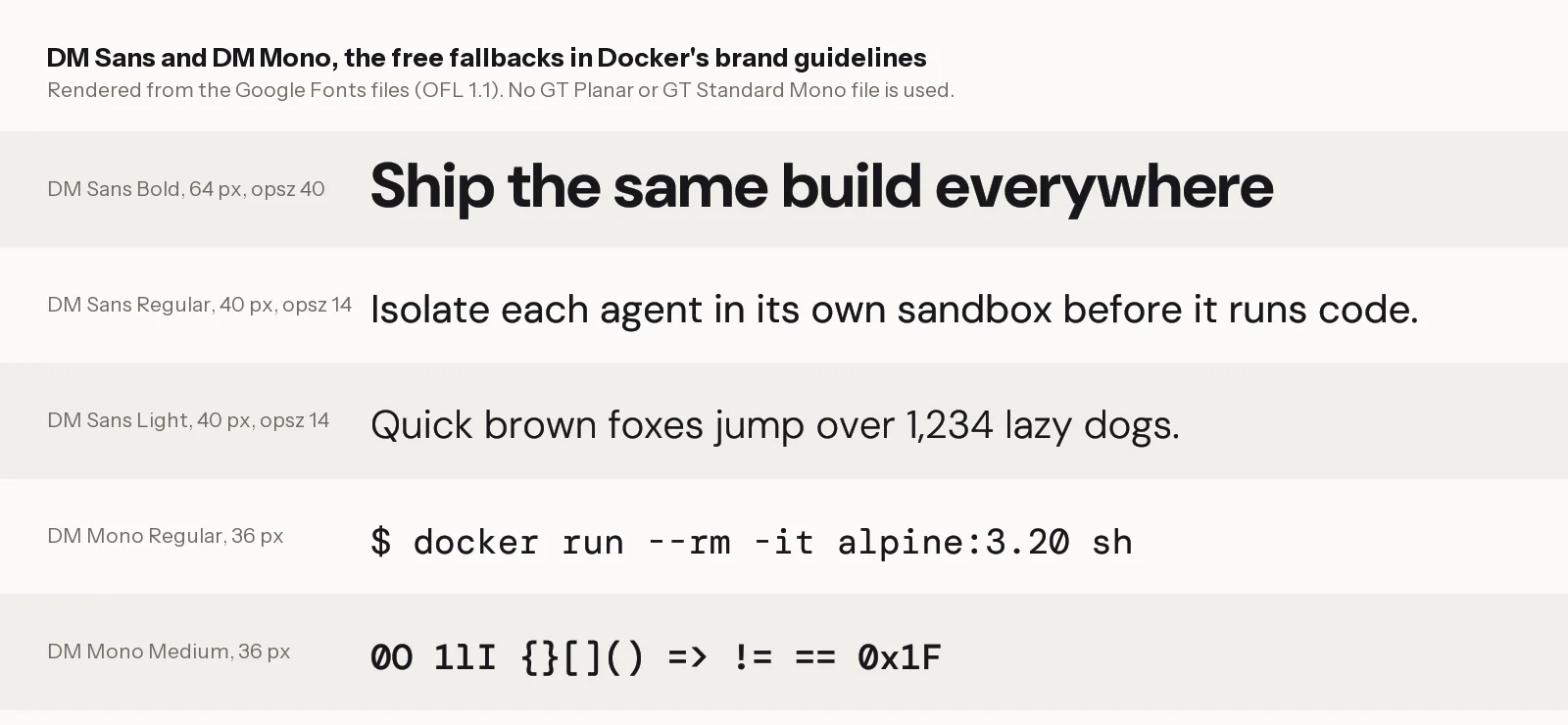
DM Sans is credited to Colophon Foundry. Google Fonts describes it as a low-contrast geometric sans, started from the Latin part of Indian Type Foundry’s Poppins. A May 2023 update widened the weight range to 100 to 1000 and added an optical size axis. The variable file has two axes: opsz from 9 to 40 and wght from 100 to 1000. It comes with a matching italic file.
DM Mono is also by Colophon Foundry, designed for DeepMind. Google Fonts says it was “loosely based off of DM Sans”. It is not variable. There are six static files: Light, Regular and Medium, each with an italic.
We measured both from the Google Fonts files with fontTools.
Heights are per 1,000 em, taken from the outlines of “x” and “H” at weight 400 and the default optical size. Our list has 11 languages: English, German, French, Spanish, Portuguese, Polish, Czech, Turkish, Vietnamese, Greek and Russian. A language counts when the file has every letter we list for it, capitals and lowercase. Neither font covers Vietnamese, Greek or Russian, so check your languages before you use them in a product.
How to set up the Docker look with free fonts
Load both fonts from Google Fonts and map them to the roles Docker uses. DM Sans takes headings and body text. DM Mono takes labels, buttons and code.
<link rel="preconnect" href="https://fonts.googleapis.com">
<link rel="preconnect" href="https://fonts.gstatic.com" crossorigin>
<link href="https://fonts.googleapis.com/css2?family=DM+Mono:wght@400;500&family=DM+Sans:opsz,wght@9..40,100..1000&display=swap" rel="stylesheet">
:root {
--font-display: "DM Sans", system-ui, sans-serif;
--font-body: "DM Sans", system-ui, sans-serif;
--font-mono: "DM Mono", ui-monospace, Menlo, monospace;
--color-base: #6172ff;
--color-canvas: #f5f2ee;
--color-ink: #1d1d1d;
}
body {
font-family: var(--font-body);
background: var(--color-canvas);
color: var(--color-ink);
}
h1, h2, h3 { font-family: var(--font-display); }
code, kbd, .label, button { font-family: var(--font-mono); }The fallback lists after each font name copy the pattern in docker.com’s own CSS. Browsers turn on optical sizing by default for fonts with an opsz axis, so DM Sans adjusts its shapes to the font size without extra CSS. The colours are three of the primary colours in Docker’s guidelines: Base, Canvas and Ink.
The fonts are free, but Docker’s logo, symbol and whale are Docker’s artwork. A font licence does not cover them.
Other free sans and mono fonts to try
If DM Sans and DM Mono don’t suit your project, these four are also free on Google Fonts under the OFL. We compare them with DM Sans and DM Mono only, because we did not measure GT Planar or GT Standard Mono. The list is not ranked.
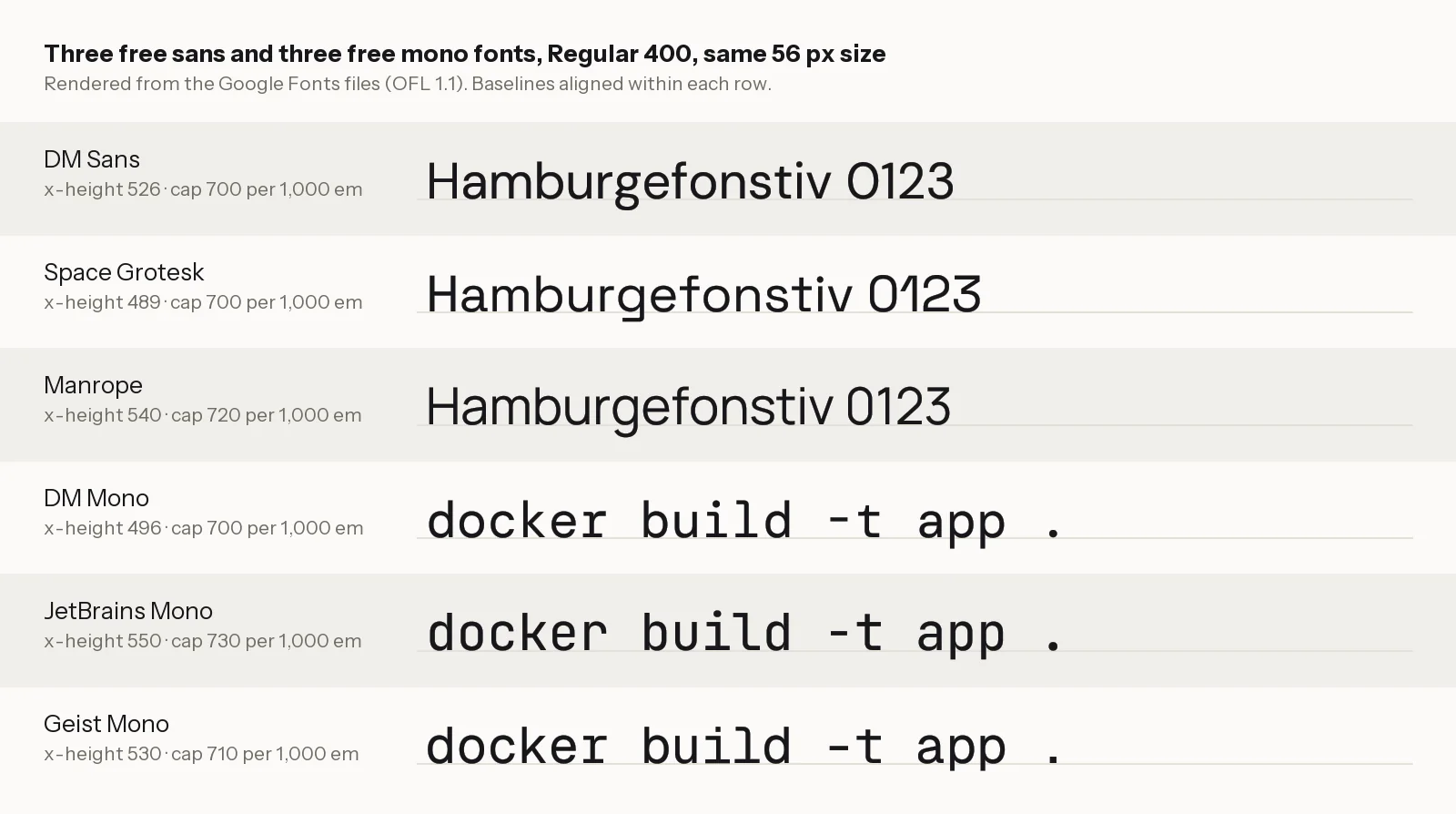
A weight range means a variable weight axis. DM Mono has three static weights. Measurements are at weight 400, per 1,000 em.
Space Grotesk by Florian Karsten has the smallest x-height of the three sans fonts, 489 against 526 for DM Sans. Its letters are wider on average, 0.556 em against 0.527 em. The Google Fonts version has no italic.
Manrope by Mikhail Sharanda is closest to DM Sans in width, 0.523 em against 0.527 em. Its x-height is 540 against 526. It adds Vietnamese, Greek and Russian. The Google Fonts version has no italic.
JetBrains Mono has the tallest x-height of the three mono fonts, 550 against 496 for DM Mono. Its file has the calt and zero OpenType features. We cover it in our terminal font guide.
Geist Mono, from Vercel’s Geist project, sits between the two at 530. Like JetBrains Mono, it has a variable weight axis and a separate italic file.
All three mono fonts use the same advance, 0.600 em per character. If you swap one for another at the same font size, a line of code keeps the same width.
For a comparison with GT Planar itself, see our GT Planar alternatives and GT Planar vs DM Sans. For GT Standard Mono, see our GT Standard Mono alternatives. For the licence terms in more depth, see our font licence decision tree.
FAQ
What font does Docker use?
Docker’s brand guidelines name GT Planar as the primary typeface and GT Standard Mono as the secondary typeface. Both are by Grilli Type. The docker.com website also uses GT Standard for paragraph text.
Is GT Planar free?
No. It is paid, licensed per style from Grilli Type. Grilli Type’s free trial fonts are for testing only. They can’t be used in websites, apps, published work or client deliverables. See our GT Planar alternatives for free options.
What is Docker’s fallback font?
DM Sans. Docker’s guidelines name it as the fallback for GT Planar “where custom fonts can’t be used”. It is free on Google Fonts under the SIL Open Font License 1.1.
What mono font does Docker use?
GT Standard Mono, from Grilli Type’s GT Standard family. The guidelines name DM Mono as its free fallback. On docker.com, the mono font is used for labels, buttons, navigation and code.
Can I use DM Sans commercially?
Yes. DM Sans and DM Mono are under the SIL Open Font License 1.1. You can use them in commercial work, websites, apps and logos, and you can embed and modify them. You can’t sell the font files by themselves.
What font is the Docker logo?
Docker has not said. Its guidelines list the logotype as one of three logo assets and do not name a font for it. GT Planar is the brand’s primary typeface for messaging and headlines, but that does not confirm it is the logo font.
What we did not verify
- Which font, if any, the “docker” logotype is based on.
- Which fonts Docker Desktop, Docker Docs and Docker Hub use.
- Which fonts Docker used before the 2026 rebrand.
- Anything about GT Planar or GT Standard Mono beyond what Grilli Type publishes. We did not open either font.
Sources and how we checked
We read Docker’s launch post and the brand guidelines page on 23 November 2026. We read the public CSS of docker.com as text, for font-family names and file names, and did not download any font file. We read Grilli Type’s GT Planar and GT Standard pages, the GT Planar minisite, the trial fonts page and the EULA on the same day. We did not download, open, measure or render GT Planar, GT Standard, GT Standard Mono or any trial font.
We pulled the six fonts, their licence files and metadata straight from Google Fonts’ source repo (snapshot 06bfe0d). We took the metrics with fontTools and rendered both pictures with Pillow. The fact-check ledger lists every claim with its source and the date we checked it.